
Ceebo interview: ‘Empathy is the only solution’
Frontline’s Elisha Kiala speaks to Ceebo, one of the UK’s rising rap stars, about his thoughtful and political project Blair


Frontline’s Ira Alecia Gardner chats to Lex Amor about her Government Tropicana mixtape, vibe acquaintances and portraying reality without sensationalising it.
Raised in North London, poet-turned-rapper Lex Amor is building her discography and supporter base organically, with creative friends and trusted collaborators. Her interest in a music career developed, perhaps subconsciously, throughout her upbringing, from drumming in church to DJing and performing poetry at open mic nights. However, music was not her first dream job. ‘I wanted to be a lawyer,’ she confesses. ‘I wanted to be a shiny suit babe. I wanted to wear the shiniest suit, just be in the city, mash, get the most money possible’.
The shiny suit dreams were hung up, however, after getting a taste of the lifestyle during a placement. ‘I wore the shiny suit for six weeks, and then after the six weeks I said “I can never do this“‘. Surrounded by creatives, the avenue of music began to present itself, and Lex diverted away from law and into music. Acknowledging that, for some, a parent’s desire for their children to do well can appear as pressure or attempts to have control, she had the complete support of her mother, citing her as a ‘dreamer’. ‘It was never like “don’t do this” or “don’t do this”… it was just like “know what you’re doing”. So, yeah, big up mummy all the time.’
From her creative process to her delivery, nothing is rushed or forced with Lex Amor. Her raw and profound lyrical content pairs with the contrasting relaxed raspiness of her voice – a product of her natural speaking cadence and recording in confined spaces during the early stages of making music. The initial plan was to perform her poetry over music, but it transitioned into rapping – the shift leading her to learn and appreciate the craft and its inner workings. ‘I entered it thinking “let me just spit a couple bars, just vibe over a beat and that,” but, you know, there’s an art to actually making something, a song… I had to learn that and spend a lot of time just learning and understanding what that meant.’

Speaking on early inspirations, she mentions friend and fellow musician Caleb Femi. ‘Caleb Femi was the first person I saw around me that was able to articulate his reality without sensationalising it… he wasn’t trying to make it sound super alluring to an outside eye, he was just speaking from his perspective.’ Similarly, Lex aims to use her music to reflect herself and reach those who identify and relate to her experiences. ‘I’m not really in it to be the best rapper in the world or to be the fastest rapper or sickest freestyler, it’s just I really want to be able to articulate a point and a time, and I want it to be representative of the time that I’m in’.
Government Tropicana is described as ‘the wine out of water story’ – the name deriving from tap water being dubbed as ‘government juice’. ‘That’s what you have, that’s what’s available, that’s what’s given to you… it’s the idea about elevating that, elevating what is given. Making the best out of what is given‘. The project encapsulates elements of childhood, her environment and life teachings – including her annual three month trip to Nigeria she took until she was 18 – which upon reflection she regards as ‘beautiful’ and representative of a culture. Referring to the mixtape as ‘bedroom studios and vibes’, the development of the project and collaborations with friends is reflective of her journey into music.
Bar Seven Days, the songs on Government Tropicana were pre-existing, never produced with the objective of being on the mixtape. However, lockdown gave Lex Amor time to review her musical journey and the songs created, finding a ‘commonality within the stories’ which eventually ended up on the project. While she currently has no favourites, 100 Angels is the one that arguably best captures the ‘essence’ of who she is, with lyrics including ‘Young black and unsung. Young black London. Raised on a raise fist. Mummy sang praises’. We also hear more vocals on 100 Angels, but she does not see herself as a singer. ‘I’ve got friends that actually sing, like, they are singers… so I’d never call myself a singer’.
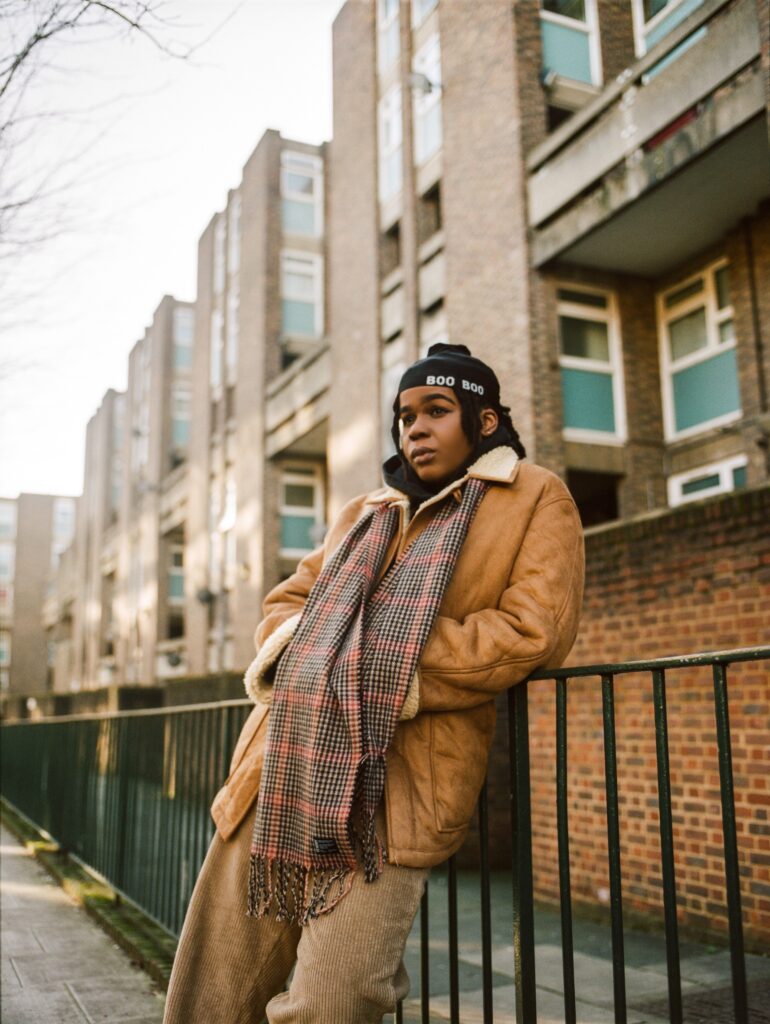
Interweaving gentle melodies in both Igbo and English, sharing her faith in God with rhymes reminiscent of her upbringing and the strength of her mother, Lex exhibits in this song and the mixtape itself what she sees the purpose of music to be. ‘I believe in preserving histories, oral histories, and telling our stories. So I believe in the role of artists to preserve histories and culture through their art, through their music’.
Like many other artists, Lex Amor is ready to be back outside with friends and what she describes as ‘vibe acquaintances’, but is especially looking forward to live shows. Where does she want to tour when she’s able to perform again? ‘South Africa. 100%. The easy question… I feel like that’s my spiritual home somehow… there’s a rage in that country, but there’s a power in that country that I love’.
Sense of self and power are constant recurring themes that arise in Lex’s music and in conversation, and she explains that it was the most important thing that was instilled in her growing up. ‘If you are in circumstance, it doesn’t make you of circumstance… being aware of what your position is in the world… I think that allows you to equip yourself to overcome it.’
Interview: Ira Alecia Gardner
Photography: Robin Niedojadło
Frontline’s Elisha Kiala speaks to Ceebo, one of the UK’s rising rap stars, about his thoughtful and political project Blair

Stationed in a black cab, decorated with Keep The Change artwork, Youngs Teflon embarked on a journey of reflection, speaking

This interview originally appeared in Frontline Issue 002: The Declaration Issue, released in March 2024. Frontline’s Davina Nylander speaks to